Listen closely, because I’m about to save you from the “tactical trap.”
I’ve watched too many greenhorns blow a month’s rent on a single boutique knife made of “super-steel” that they’re too afraid to actually use. They think a $400 price tag buys them skill. It doesn’t. It buys them a shiny paperweight. If you lose that knife in a swamp or snap the tip prying a knot, you’re not just out of a tool: you’re out of luck and out of cash.
At Dragonfire Tactical, we believe in the “Common Man” philosophy: tools that are inexpensive but bulletproof.
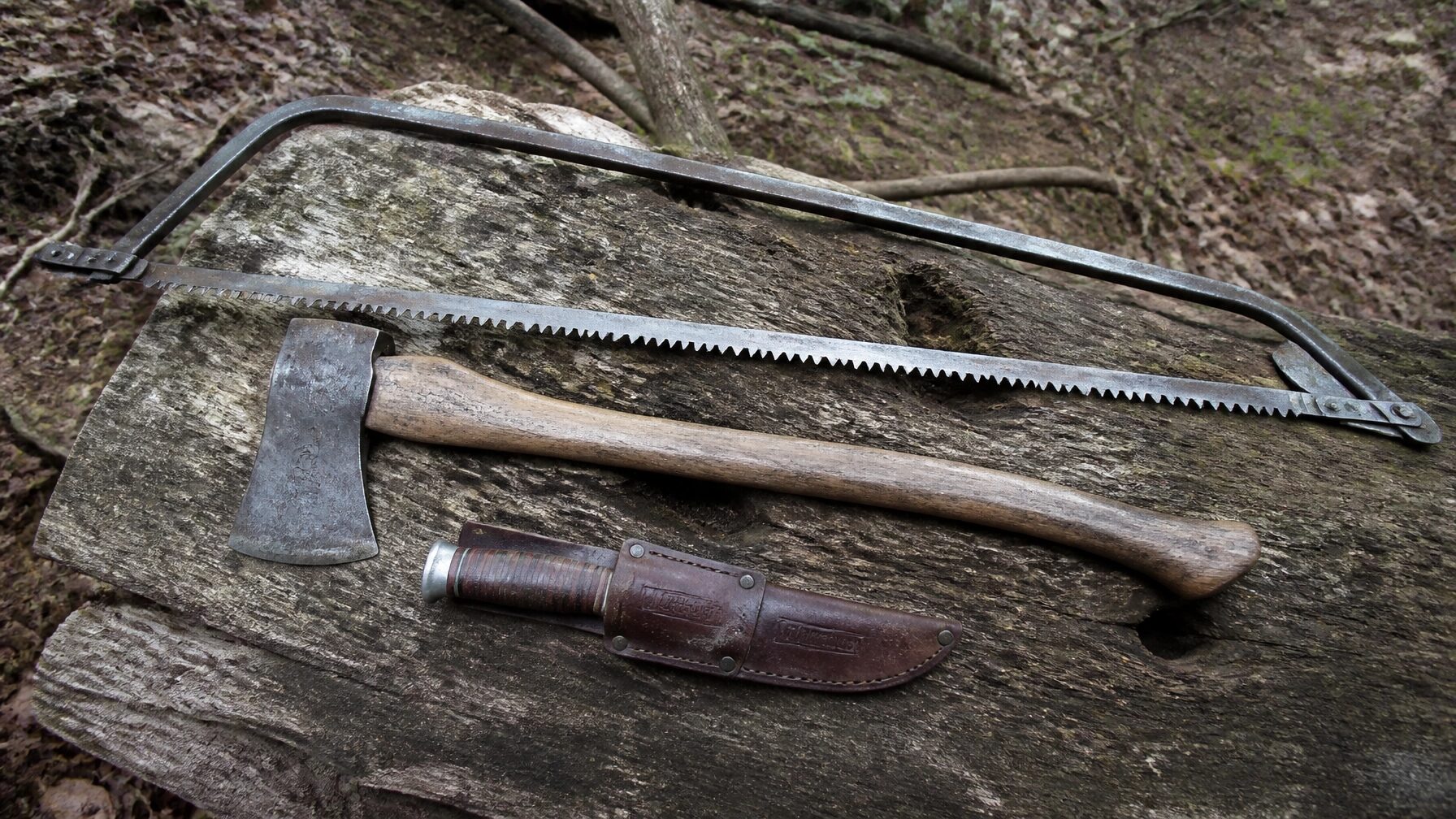
We’re talking about a complete cutting system: axe, saw, primary knife, and backup: for less than $65. If you can’t survive with this kit, the problem isn’t the gear; it’s you. You need to distinguish between your strategy: the overarching plan for self-sufficiency: and your tactics: the specific way you swing the blade.
Here is how you build a professional-grade bushcraft kit without emptying your savings.
The Strategy: Why Budget Doesn’t Mean Cheap
When I say “budget,” the ignorant think of flimsy plastic and pot metal. They’re wrong.
In the wilderness, bulletproof means a tool you can stake your life on every day and twice on Sunday. It means 1095 high carbon steel, tubular metal frames, and refurbished American iron.
Think of your gear budget like your daily calorie intake. If you spend all your “calories” on one overpriced steak (a custom knife), you’re going to starve when you need energy for the rest of the day (axes, saws, and cordage). We balance the scales so you have every tool required for high-level bushcraft skills.
The Heavy Hitter: The $15 Scrapyard Axe
An axe is the king of the woods. Without one, you’re just a guest in the forest.
You don’t need a $200 Swedish forest axe. Go to a scrapyard, a flea market, or a yard sale. Look for an old American-made head: Plumb, Collins, or Kelly. You can usually snag a solid head for $3. Spend $12 on a good hickory handle.
For $15 and an hour of “elbow grease” with a file, you have a tool that will outlive you.

Tactical Insight: Single Bit vs. Double Bit
If you find a double-bit cruiser axe, grab it. Historically, 19th-century teamsters used these for road clearing. They kept one edge razor-sharp for felling and used the other for “rough work”: hitting roots or frozen wood where rocks might hide.
It’s a two-in-one strategy. Just remember: a double-bit is more dangerous to wield. If you don’t have the “guts” to respect the blade, stick to a single bit.
Wood Processing Efficiency: The $10 Bow Saw
I see “survival experts” all the time carrying just a saw blade, planning to “make a frame in the woods.”
That’s a fool’s errand.
A tubular metal bow saw frame weighs almost nothing. It costs $10 at any hardware store. Why would you waste thirty minutes of daylight and precious calories trying to fashion a shaky wooden frame when you could just pull the real tool out of your pack and get to work?
Bushcraft techniques are about efficiency, not making things harder for the sake of looking “primitive.” Carry the whole saw. Cover the blade with a piece of old garden hose for safety. It’s bulletproof, lightweight, and saves your energy for things that actually matter: like not freezing to death.
The Blade Core: Old Hickory and the Mora
Your knife is your most intimate tool. But it doesn’t need to be fancy.
The Primary: Old Hickory Butcher Knife ($11)
The 7-inch Old Hickory butcher knife is a legend for a reason. It’s 1095 high carbon steel. It’s Full Tang. It’s made in the USA.
Most importantly, it has a 90-degree spine. This isn’t just a “tactical” look; it’s a functional necessity. A sharp spine allows you to scrape a ferro rod or process tinder without dulling your primary edge.
- Cost of knife: $11
- Cost of leather sheath: $10 (Check local leatherworkers or the Amish)
- Total: $21 for a knife that will do 99% of what a $300 custom knife does.
The Backup: The Mora ($12-$15)
Every kit needs redundancy. The Mora (like the Companion or the 511) is the ultimate backup. It’s not Full Tang: it’s a rat-tail tang: but for fine carving, skinning, and food prep, it’s unbeatable.
For $15, you get a razor-sharp Scandi grind that is a dream to maintain. If you break it, you haven’t lost your inheritance. You just buy another one.

The Multi-Tool Hack: Vice Grips and Side-Cuts ($3)
You don’t need a $150 butterfly-opening multi-tool. Half the tools on those things are useless “filler” anyway.
Go to a flea market and find a pair of vice grips or side-cut pliers for $3. Why? Because these give you a “third hand.” You can use vice grips to clamp onto a reciprocating saw blade to create a small, precision folding saw for notching.
They also allow you to manipulate hot metal near a fire or cut wire for traps. This is tactical prepping at its most basic: using simple mechanical advantages to solve complex problems.
The $65 Bulletproof Breakdown
Let’s do the math. Are you paying attention?
- Refurbished Axe: $15
- Metal Bow Saw: $10
- Old Hickory + Sheath: $21
- Mora Backup Knife: $15
- Vice Grips/Pliers: $3
- Saw Blades/Small Hacks: $1
TOTAL: $65.
For sixty-five dollars, you have a cutting system that can fell trees, process firewood, carve trap triggers, and dress game. You have redundancy in your knives and specialized tools for both heavy and fine work.
The “fools” will spend ten times this amount and still struggle to start a fire in the rain. Why? Because they bought gear instead of gaining skills.

Your Resolve is the Final Tool
I’ve given you the list. I’ve shown you the logic. Now, the execution rests entirely on your guts.
You can go online right now and find these items. You can spend your Saturday at a flea market digging through bins of old steel. Or you can keep scrolling, waiting for the “perfect” expensive kit to go on sale.
The wilderness doesn’t care about your brand names. It only cares if your blade is sharp and your resolve is steady. Build this kit. Learn how to use it. Don’t be the person who is “all gear and no grit.”
Stay sharp, stay self-sufficient.
( elitemember)
Based on this video: